
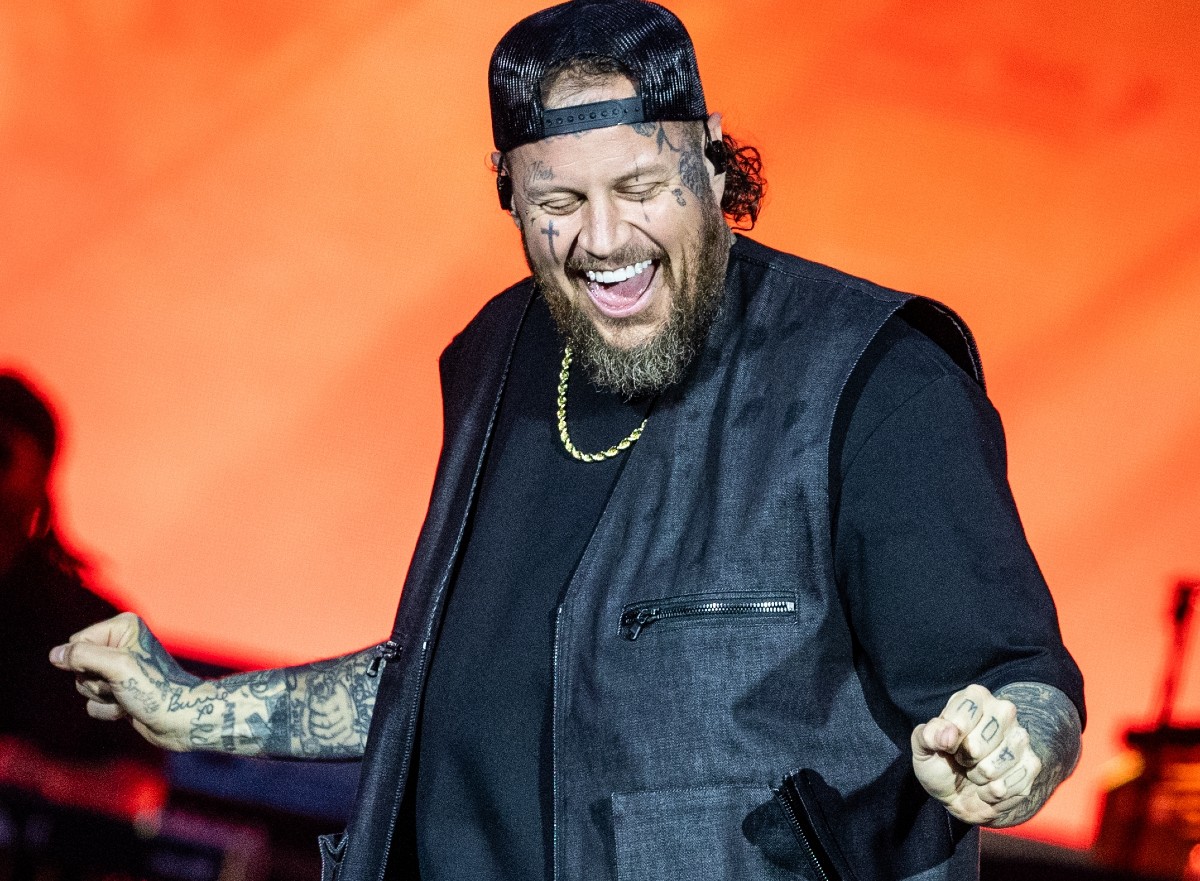
Jelly Roll is a much leaner man than he used to be. In a new issue of Men’s Health, the 41-year-old opens up about his fitness journey, which began when he weighed more than 520 pounds. Now under 265, Jelly Roll reveals why he is now more focued on his health than ever before.
By his own admission, his weight was the result of a food addiction, just like he was addicted to drugs and alcohol. Jelly Roll got into therapy, determined to become the best version of himself that he could possibly be.
“I started treating my food addiction like what it was: an addiction,” Jelly Roll says. “Why did I treat cocaine a certain way? I went to meetings for cocaine and found a sponsor and detoxed off of it and sh– myself and went through real hard life-changing emotional choices to get off cocaine and codeine.
“I didn’t look at the food addiction different,” he adds. “Once I started treating food like an addiction, it started changing everything for me. When I started really looking at the source of why I was eating. What was I eating for?”
View this post on Instagram
Why Jelly Roll Was So Overweight
Jelly Roll has been open about his traumatic childhood, with a mother who battled mental illness, in a lower-income neighborhood, where drugs and gangs were prevalent. His quest to belong, to feel part of something, is what led him to a decade in and out of prison.
“I felt guilty about every decision I made in my teenage years, and that my default was to double down on them because I would have been embarrassed to back out of them,” Jelly Roll says. “The ego of a young man had me wanting to be a thug so bad, had me wanting to be connected with the street so bad. Had me wanting to be something I wasn’t. It took 12, 15 years of being in and out of the system and going through sh– and dealing with drugs and drug addicts to realize, man, that was never actually who I was.”
He might have seemed tough on the outside, but inside, he was always struggling, both internally and externally.
“It was never-ending sadness,” Jelly Roll admits. “And anger. I was a prisoner to my own body … Washing myself properly was a problem. Getting in cars. Every decision I made in life had to be based on my weight. If it could hold me, facilitate me, or fit me—people don’t think about every facet of ‘I still want to be able to do that and I can’t.’ I was so inspired by that kind of stuff.”
How Jelly Roll Started to Get Healthier
In 2021, the Nashville native began working with The Ultimate Human. At the time, Jelly Roll’s goal was simple: to get under 500 pounds
“I was so fat that I took that weekend, and I fasted and just ate a couple of chicken noodle soups,” he recalls. “When I came in under 500, I was like, ‘I’m finally under 500 pounds!’ But I was privately thinking, ‘Dude … I’m sending a grown man a picture of me on the scale at almost 500 pounds.”
Determined to make changes that would last, the “Save Me” singer went to Ways2Well, a wellness clinic with a multi-faceted approach. Perhaps surprisingly, Jelly Roll wanted to lose all of the weight, more than half of his body, without drugs or medicine. Not surprisingly, his initial bloodwork revealed he was a walking miracle.
“The first couple of blood panels were like, how are you alive?” Jelly Roll recount.
Now, Jelly Roll has a live-in chef, who cooks for him on the road. He also prioritizes exercise, both weights and cardio.
The Importance of Jelly Roll’s ‘Men’s Health’ Cover
When Jelly Roll was still morbidly obese, he set what seemed at the time to be an audacious goal. While speaking on his wife’s Bunnie Xo’s Dumb Blonde podcast, he set his sights on being a picture of health. When he was in jail, he would read Men’s Health, knowing he was anything but healthy. Years later, he wanted to prove he could change, and be the man he at one time thought would be impossible.
“I want to be on the cover of Men’s Health by March of 2026,” Jelly Roll said at the time. “That’s my new goal. I want to have one of the biggest transformations.”
Mission accomplished.